Krypton
Personal AI chief of staff — a Claude Code plugin that synthesizes intelligence across the entire Agentic Work System, answering the questions that no single system can answer alone.
The Problem
The Agentic Work System has multiple specialized components: the Knowledge Base knows what’s been learned, Memory knows what’s been observed, ADF knows what projects are in flight, Work Management knows what’s in the backlog. Each component answers its own questions well.
But no single component can answer the question that matters most: “What should I work on right now?”
Krypton sits above all of it. It doesn’t own any data — it synthesizes across systems and surfaces insight that only exists at the intersection.
What It Does
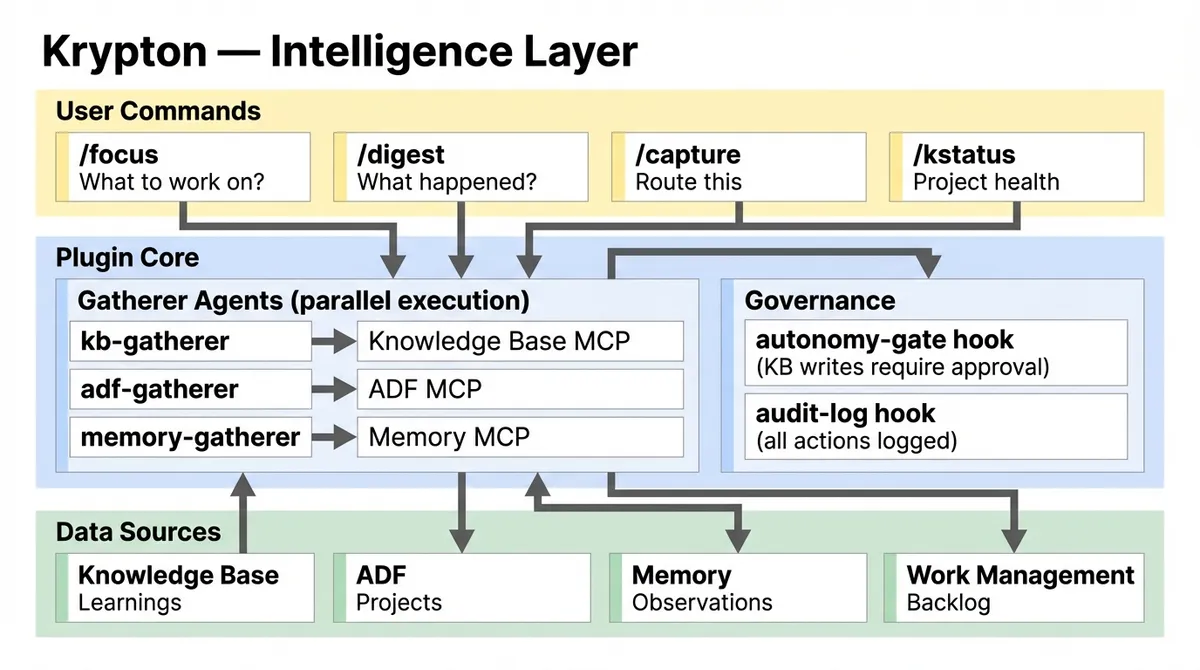
Four commands, each answering a distinct question:
/krypton:focus — “What should I work on?” Queries KB, Memory, ADF, and Work Management in parallel. Ranks by momentum, blockers, KB connections, and observed patterns. Returns top 3 priorities with source attribution ([KB], [ADF], [Memory]) and cross-system connections.
/krypton:digest — “What happened recently?” Activity summary grouped by source. Default: last 7 days. Surfaces cross-source patterns — when the same theme appears in KB entries, memory observations, and ADF project activity simultaneously.
/krypton:capture — “Save this.” Analyzes content and routes it to the right system: KB for learnings and ideas (with approval), Memory for preferences and observations (autonomous). Routing confidence and destination surfaced before execution.
/krypton:kstatus — “How are my projects?” Cross-project health dashboard. Stage, health, next step, and blockers for every ADF project in a single table.
Architecture
┌─────────────────────────────────────────┐
│              Krypton Plugin             │
├─────────────┬─────────────┬─────────────┤
│  Commands   │   Agents    │    Hooks    │
│  focus      │ kb-gatherer │ autonomy    │
│  digest     │ adf-gatherer│ audit-log   │
│  capture    │ mem-gatherer│             │
│  kstatus    │             │             │
├─────────────┴─────────────┴─────────────┤
│           Data Sources (MCP)            │
│  Knowledge Base │ ADF │ Memory │ WM     │
└─────────────────────────────────────────┘
Each command dispatches specialized sub-agents (gatherers) to query the relevant systems in parallel, then synthesizes results. No single gatherer has the full picture — synthesis happens in Krypton, not in the underlying systems.
The Autonomy Hook
Krypton’s capture command uses an autonomy hook to govern what it can do without asking. Writes to Memory are autonomous — low-stakes, easily reversible. Writes to KB require approval — higher-stakes, permanent unless manually archived.
This is a small but real example of AGF’s governance patterns in practice: different trust levels for different actions, enforced at the agent boundary.
Design Philosophy
Krypton deliberately doesn’t own data. It’s an intelligence layer, not a data layer. This means:
- It has no migration cost if any underlying system changes
- Its value is entirely in reasoning, not storage
- It fails gracefully if any single source is unavailable
The tradeoff is that Krypton is only as good as the systems it queries. If the Knowledge Base isn’t being maintained, Krypton’s recommendations degrade. The quality of cross-system intelligence is a direct function of the quality of the underlying systems.
Connection to the Agentic Work System
Krypton is the Intelligence Ring — it provides reasoning, synthesis, and strategic awareness across all layers. It’s the closest thing the system has to a persistent cognitive layer above the operational components.