Work Management
The execution spine of the Agentic Work System — a Next.js + Supabase system of record for all projects, plans, tasks, and backlog, with a full MCP adapter for agent-driven orchestration.
The Problem
ADF defines how development projects move through stages. But work isn’t only software development — it’s consulting, board work, business operations, personal projects, and every other domain where things need to get done. A system that only tracks ADF projects misses most of the actual work.
Work Management is the execution spine that tracks all of it, with a design that makes it accessible to both humans (via a Next.js UI) and agents (via a full MCP adapter).
Architecture
Two applications, one system:
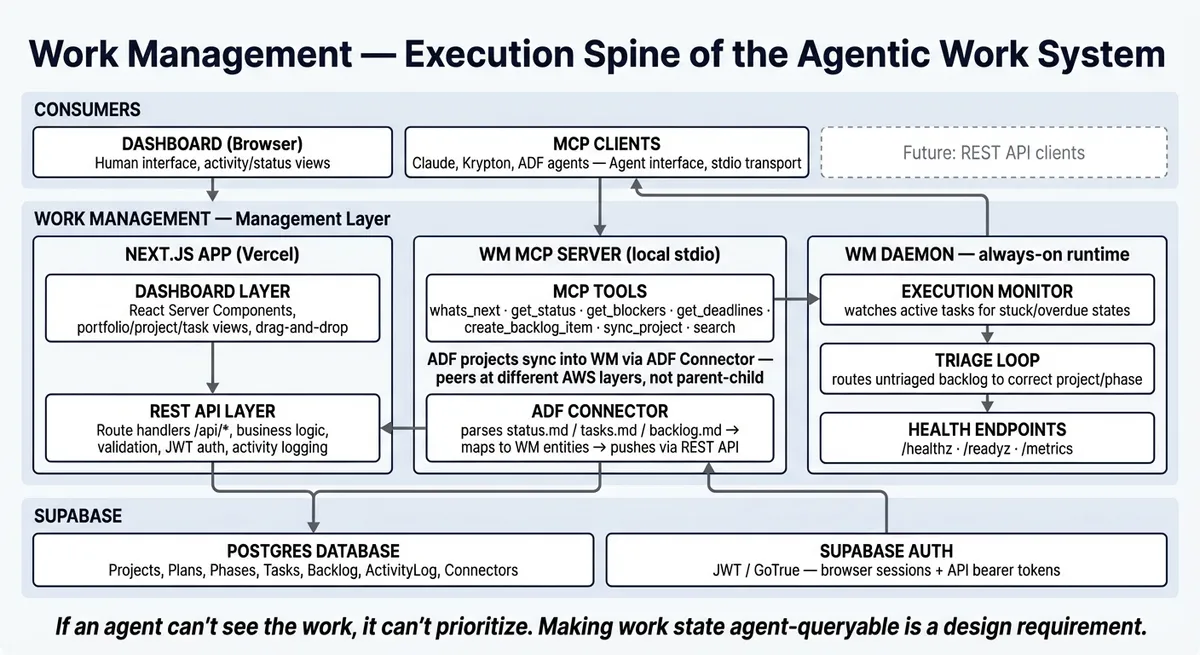
Main App (/) — Next.js App Router, Supabase backend. The human interface: projects, plans, phases, tasks, backlog, activity. A system of record, not a task manager. It tracks state and flow; it doesn’t drive them.
MCP Server (/mcp-server) — stdio or SSE transport. The agent interface: exposes the same data model to any authorized agent. An ADF agent can read its current task list, update status, create backlog items, and query blockers — without touching the UI.
The WM Daemon
The daemon is what makes Work Management genuinely operational rather than just a data store:
npm run wm:daemonAlways-on runtime with:
- Execution monitor — watches active tasks for stuck states, overdue items, missing updates
- Triage loop — routes untriaged backlog items to the right project/phase
- Health endpoints:
/healthz,/readyz,/metrics,/ops/jobs
This is the closest WM gets to autonomy: the daemon makes decisions about work routing and escalation without waiting for human input. It’s deterministic — rule-based, not LLM-driven — but it runs continuously and acts.
Relationship to ADF
ADF and Work Management are peers, not parent-child. Both operate within the AWS architecture at different levels:
- ADF operates in the Operations layer — it governs how development projects move through stages
- WM operates in the Management layer — it’s the execution spine for all work, development and otherwise
ADF projects sync into WM via ADF connectors (npm run test:adf-sync). WM doesn’t live within ADF, and ADF doesn’t depend on WM — but they’re designed to complement each other at their respective layers.
Why an Agent-Accessible Work OS
The MCP adapter exists because human-only interfaces create agent blindspots. If an ADF agent can’t see the full backlog, it can’t prioritize. If Krypton can’t query work state, its cross-system recommendations are incomplete. Making work state agent-queryable is a design requirement, not a nice-to-have.
The whats_next, get_status, get_blockers MCP tools are the most-used by agents. They answer the question agents most often ask: “what should I be working on right now?”
Connection to the Agentic Work System
WM is Management layer infrastructure. Every project in the AWS ecosystem — ADF builds, open source tools, client work — has a corresponding entry in WM. The backlog is the source of truth for what needs to happen. The daemon enforces flow.