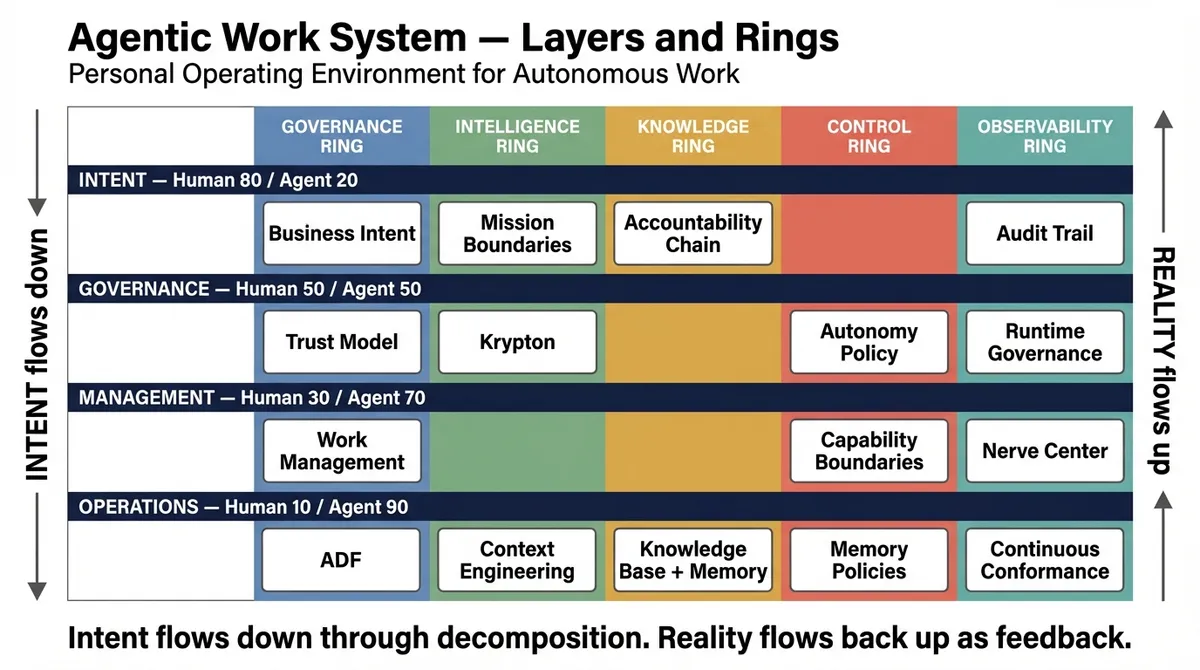
Agentic Work System (AWS)
A personal operating environment for autonomous, agent-driven work — built on a layers-and-rings architecture, developed iteratively in parallel with the AGF framework it's proving out.
Building While Racing
AWS is not a finished system. It’s a live one, being built in parallel with the work it supports. New components get added when a gap becomes painful enough to fill. Existing components get redesigned when practice reveals a better pattern. The architecture evolves from use, not from planning in isolation.
This is intentional. The goal isn’t to design the perfect agentic work system in theory — it’s to discover what one actually requires by building it, running it, and learning from what breaks.
AGF captures those learnings as a reusable framework. AWS is the proof that the framework reflects something real.
The Architecture: Layers and Rings
Two orthogonal structures compose the system:
Layers stack vertically — they represent the work at different altitudes. Intent flows down through decomposition; reality flows back up as feedback. Each layer takes intent from above, decomposes it, passes it down, and returns outcomes.
INTENT          Human: 80 / Agent: 20
    ↓
GOVERNANCE      Human: 50 / Agent: 50
    ↓
MANAGEMENT      Human: 30 / Agent: 70
    ↓
OPERATIONS      Human: 10 / Agent: 90
Rings wrap horizontally around every layer — support infrastructure that enables each layer to function. The same rings appear at every altitude, instantiated differently based on the human-agent ratio at that level:
| Ring | Function |
|---|---|
| Governance Ring | Alignment, policy, constraints |
| Intelligence Ring | Reasoning, analysis, sensing |
| Knowledge Ring | Memory, KB, instructions, context |
| Control Ring | Guardrails, capabilities, permissions |
| Observability Ring | Traceability, auditability, monitoring |
The Components
Each component serves a specific ring or layer function. They’re not independent tools that happen to coexist — they’re designed to interoperate, with defined data flows and integration contracts between them.
| Component | Layer / Ring | Role |
|---|---|---|
| ADF | Operations layer | Development lifecycle — stage gates, agent roles, governance |
| Work Management | Management layer | Execution spine — all work tracked in one system |
| Nerve Center | Observability ring | Monitoring, alerting, ops interface |
| Krypton | Intelligence ring | Cross-system synthesis — chief of staff |
| Knowledge Base | Knowledge ring | Curated learnings, searchable via MCP |
| Memory | Knowledge ring | Persistent agent memory, cross-session recall |
| Link Triage | Knowledge ring | Content intake pipeline — feeds the KB |
What This Produces
AWS is a factory for outcomes — sometimes an app, sometimes a workflow, sometimes a published framework. The outputs vary; the underlying system is consistent.
The content on this site was produced using ACM, which is itself a downstream product of the system. The AGF diagrams were generated using Diagram Forge. The research that informed the Memory architecture was processed through Link Triage and surfaced by the Knowledge Base.
The system is self-documenting in the sense that building it is what surfaced the patterns now being codified in AGF.